
Reading in French
Reading is by far the easiest French skill for an English speaker. Here is why, and where the page and the ear part company.
Les étoiles brillent la nuit.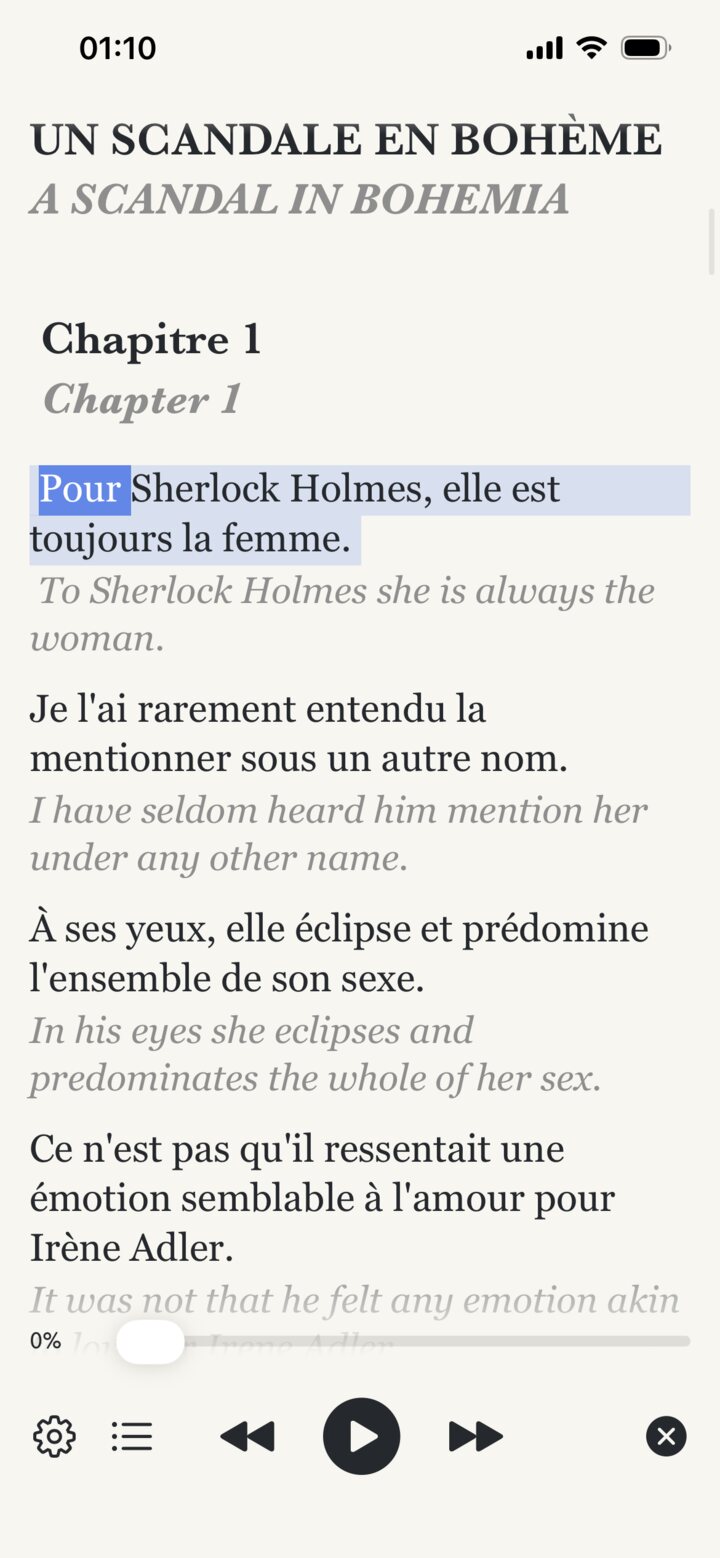
What reading French is actually like
Roughly a third of English vocabulary arrived from French, which means you can already read more French than you think. Words like nation, table, silence, important and impossible are shared outright, and thousands more are a small step away.
The catch is that French spelling and French sound diverged centuries ago and never reconciled. Final consonants usually go unpronounced, whole endings like -ent vanish in speech, and words run together in ways the page never shows. This is why French reading runs so far ahead of French listening.
That gap is an argument for reading with audio rather than against reading. Seeing parlent while hearing "parl" is how the two halves of the language get reconnected.
- Silent endings are the rule
- The final consonant of most French words is written but not said. parlent and parle sound identical. Reading first, then hearing it, is the fastest way to internalise this.
- Accents change meaning
- ou is "or", où is "where". The marks are not decoration, and skipping them is the most common way to misread a sentence.
- False friends are frequent
- actuellement means currently, not actually. librairie is a bookshop, not a library. The shared vocabulary is a gift with a few traps in it.
How much French can you read already?
Six real sentences, easiest first. Read each one, and reveal the meaning when you want it. In a book the translation is simply always there — this hides it so you can see where you stand. It is a gauge, not a placement test.
Sentence 1 of 6
0 understood
J'adore les animaux.
Your first 48 words in French
Every entry carries a real sentence and its translation, because a word on its own is much harder to keep than a word in use. Read them here; the app has over 1,400 more.
Greetings
| French | English | In a sentence |
|---|---|---|
| bonjourbohn-zhoor | hello/good morning | Bonjour, comment allez-vous?Hello, how are you? |
| bonsoirbohn-swahr | good evening | Bonsoir, madame.Good evening, madam. |
| bonne nuitbon nwee | good night | Bonne nuit, fais de beaux rêves.Good night, sweet dreams. |
| salutsah-loo | hi/bye | Salut! Ça va?Hi! How's it going? |
| au revoiroh ruh-vwahr | goodbye | Au revoir et à bientôt!Goodbye and see you soon! |
| à bientôtah byahn-toh | see you soon | À bientôt, mon ami!See you soon, my friend! |
| à demainah duh-man | see you tomorrow | À demain à la même heure.See you tomorrow at the same time. |
| mercimehr-see | thank you | Merci beaucoup pour votre aide.Thank you very much for your help. |
Numbers
| French | English | In a sentence |
|---|---|---|
| zérozay-roh | zero | La température est à zéro degré.The temperature is at zero degrees. |
| unuhn | one | J'ai un frère.I have one brother. |
| deuxduh | two | J'ai deux sœurs.I have two sisters. |
| troistrwah | three | Il y a trois pommes.There are three apples. |
| quatrekatr | four | Une année a quatre saisons.A year has four seasons. |
| cinqsank | five | J'ai cinq doigts à chaque main.I have five fingers on each hand. |
| sixsees | six | Il est six heures.It is six o'clock. |
| septset | seven | Une semaine a sept jours.A week has seven days. |
Family
| French | English | In a sentence |
|---|---|---|
| famillefah-mee | family | Ma famille est grande.My family is big. |
| pèrepehr | father | Mon père travaille à Paris.My father works in Paris. |
| mèremehr | mother | Ma mère est médecin.My mother is a doctor. |
| parentspah-rahn | parents | Mes parents habitent en province.My parents live in the countryside. |
| filsfees | son | Mon fils a dix ans.My son is ten years old. |
| fillefee | daughter | Ma fille est étudiante.My daughter is a student. |
| enfantahn-fahn | child | L'enfant joue dans le jardin.The child plays in the garden. |
| frèrefrehr | brother | Mon frère est plus âgé que moi.My brother is older than me. |
Food & Drinks
| French | English | In a sentence |
|---|---|---|
| painpan | bread | J'achète du pain frais tous les jours.I buy fresh bread every day. |
| eauoh | water | Je voudrais un verre d'eau, s'il vous plaît.I would like a glass of water, please. |
| fromagefroh-mahzh | cheese | La France produit de nombreux fromages.France produces many cheeses. |
| viandevyahnd | meat | Je ne mange pas de viande.I don't eat meat. |
| pouletpoo-leh | chicken | Le poulet rôti est délicieux.Roast chicken is delicious. |
| bœufbuhf | beef | Je prends un steak de bœuf.I'll have a beef steak. |
| porcpohr | pork | Les côtelettes de porc sont savoureuses.Pork chops are tasty. |
| légumelay-goom | vegetable | Les légumes sont bons pour la santé.Vegetables are good for health. |
Colors
| French | English | In a sentence |
|---|---|---|
| rougeroozh | red | La voiture rouge est rapide.The red car is fast. |
| bleubluh | blue | Le ciel est bleu.The sky is blue. |
| vertvehr | green | L'herbe est verte.The grass is green. |
| jaunezhohn | yellow | Le soleil est jaune.The sun is yellow. |
| orangeoh-rahnzh | orange | J'aime la couleur orange.I like the color orange. |
| violetvee-oh-leh | purple | Elle porte une robe violette.She wears a purple dress. |
| roserohz | pink | Les fleurs sont roses.The flowers are pink. |
| noirnwahr | black | Le chat noir dort.The black cat sleeps. |
Days & Months
| French | English | In a sentence |
|---|---|---|
| lundiluhn-dee | Monday | Lundi est le premier jour de la semaine.Monday is the first day of the week. |
| mardimahr-dee | Tuesday | Je vais au cinéma mardi.I go to the cinema on Tuesday. |
| mercredimehr-kruh-dee | Wednesday | Les enfants n'ont pas école mercredi.Children don't have school on Wednesday. |
| jeudizhuh-dee | Thursday | La réunion est jeudi.The meeting is on Thursday. |
| vendredivahn-druh-dee | Friday | Vendredi, c'est le début du weekend.Friday is the start of the weekend. |
| samedisahm-dee | Saturday | Samedi, nous allons au marché.On Saturday, we go to the market. |
| dimanchedee-mahnsh | Sunday | Dimanche est un jour de repos.Sunday is a day of rest. |
| janvierzhahn-vyay | January | Janvier est le premier mois de l'année.January is the first month of the year. |
Then read a whole book
Word lists run out. 61 books, each sentence printed with English directly beneath it and every book graded by reading difficulty, so you can start one before you feel ready. The device above is Un scandale en Bohème — Conan Doyle’s first Sherlock Holmes story, in French.
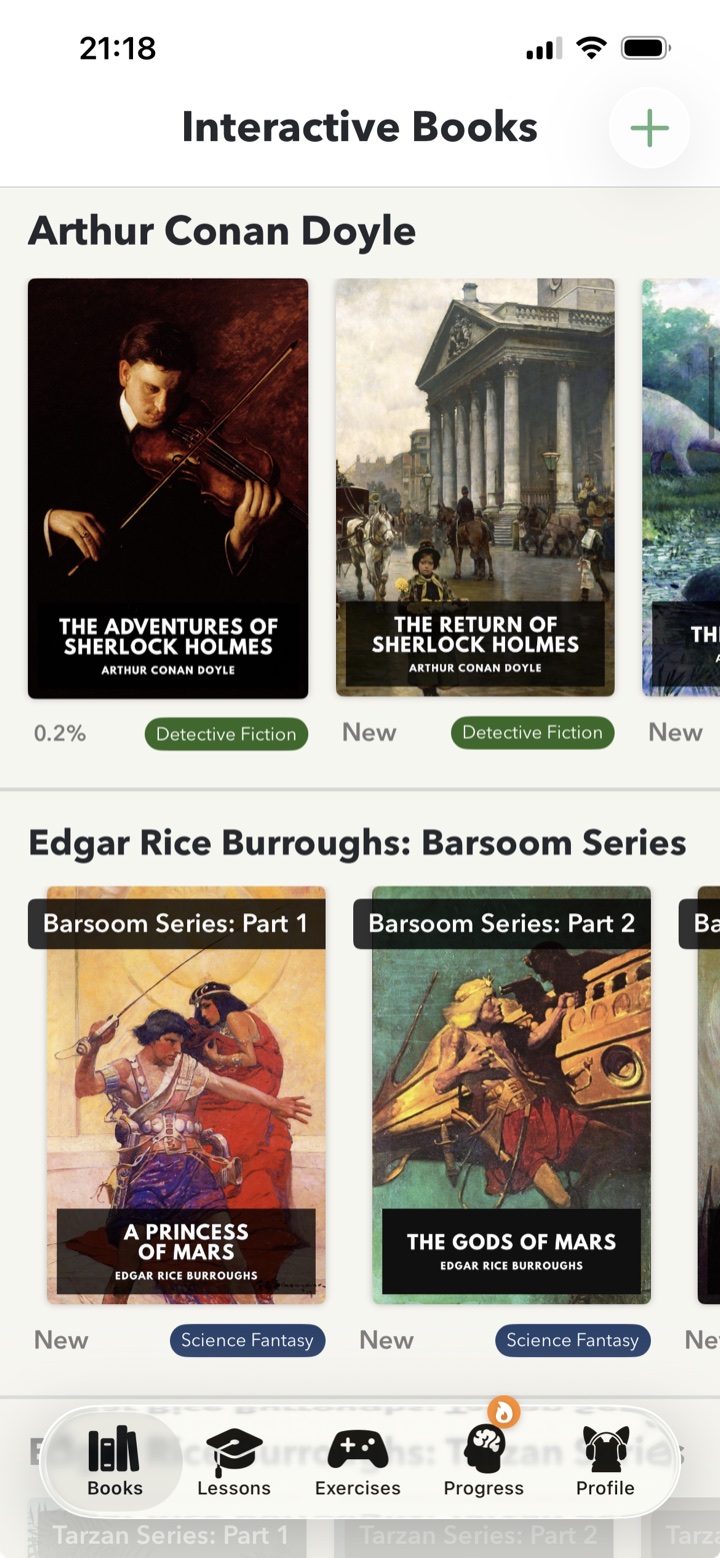
- The Adventures of Tom SawyerMark TwainEasy
- The Adventures of Sherlock HolmesArthur Conan DoyleEasy
- The Wonderful Wizard of OzL. Frank BaumEasy
- A Christmas CarolCharles DickensEasy
- Peter PanJ. M. BarrieEasy
- The Adventures of PinocchioCarlo CollodiEasy
Read your first French book
Free on the App Store

Scan to install on your iPhone