Reading in German
German has a reputation for difficulty that reading does not really deserve. Here is what actually gets in the way.
Der Sonnenaufgang ist schön.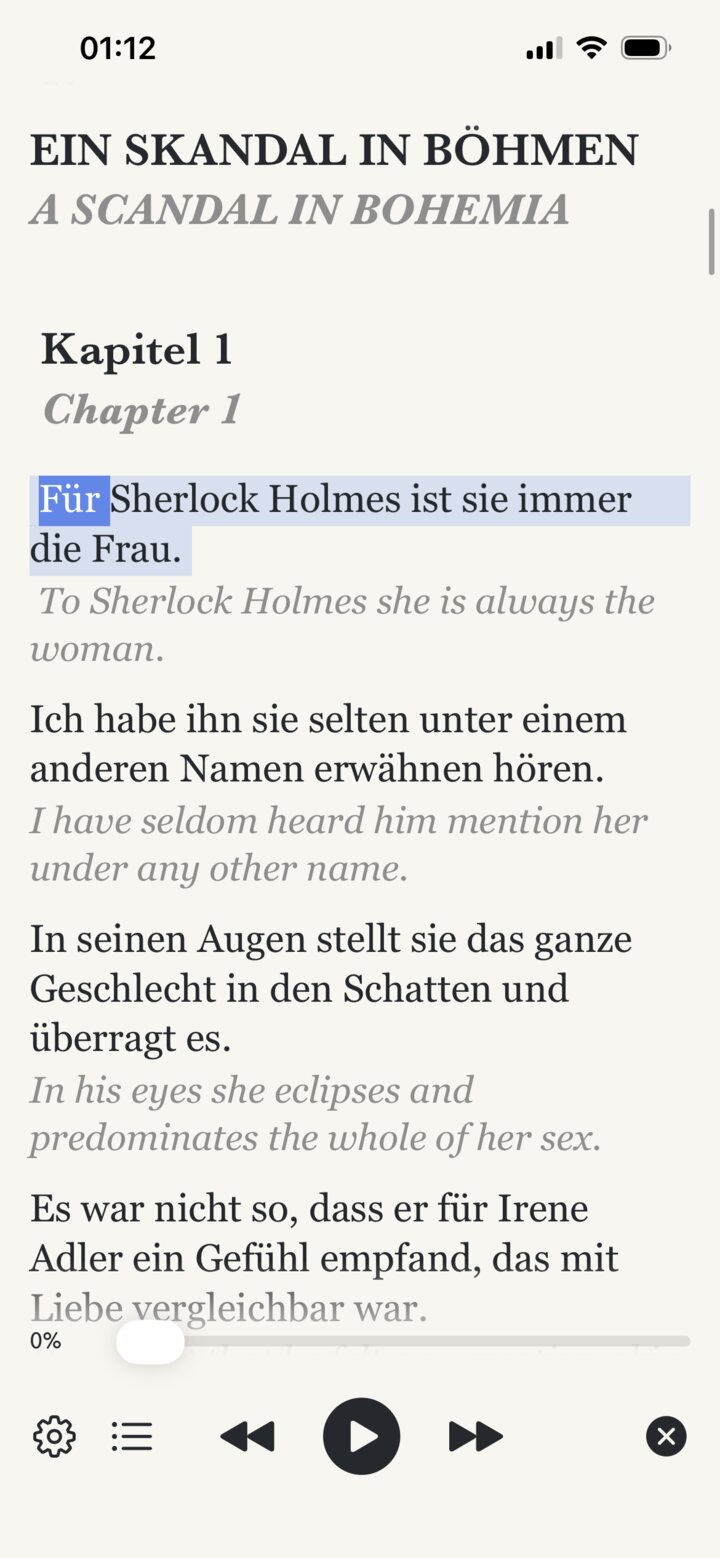
What reading German is actually like
German and English are cousins, and it shows on the page more than in conversation. Wasser, Haus, Buch, Hand, Finger, Sommer — the Germanic core of English is sitting right there, and a surprising amount of simple German is legible on sight.
German spelling is also far more regular than English. Letters map to sounds consistently, so pronunciation follows from the page without the guesswork French demands.
What makes German feel hard is grammar you can see: three genders, four cases, and a habit of sending the verb to the very end of a subordinate clause. That last one is the real reading skill — you sometimes have to hold a whole sentence in your head before it resolves.
- Every noun is capitalised
- This looks strange and is actually a gift. Capitals tell you where the nouns are, which makes a long sentence far easier to parse than the equivalent in English.
- Long words come apart
- Handschuh is hand-shoe, a glove. Geschwindigkeitsbegrenzung is a speed limit. German compounds are intimidating until you start splitting them, then they become clues.
- The verb may be at the end
- In subordinate clauses the verb moves last, so meaning arrives late. Reading trains this patience better than drills do.
How much German can you read already?
Six real sentences, easiest first. Read each one, and reveal the meaning when you want it. In a book the translation is simply always there — this hides it so you can see where you stand. It is a gauge, not a placement test.
Sentence 1 of 6
0 understood
Der Hund bellt.
Your first 48 words in German
Every entry carries a real sentence and its translation, because a word on its own is much harder to keep than a word in use. Read them here; the app has over 1,400 more.
Greetings
| German | English | In a sentence |
|---|---|---|
| Hallohah-loh | Hello | Hallo, wie geht's?Hello, how are you? |
| Guten Morgengoo-ten mor-gen | Good morning | Guten Morgen, Herr Müller.Good morning, Mr. Müller. |
| Guten Taggoo-ten tahk | Good day | Guten Tag, wie kann ich helfen?Good day, how can I help? |
| Guten Abendgoo-ten ah-bent | Good evening | Guten Abend, meine Damen und Herren.Good evening, ladies and gentlemen. |
| Gute Nachtgoo-tuh nahkht | Good night | Gute Nacht, schlaf gut.Good night, sleep well. |
| Auf Wiedersehenowf vee-der-zay-en | Goodbye | Auf Wiedersehen und bis bald.Goodbye and see you soon. |
| Tschüsschoos | Bye | Tschüss, bis morgen!Bye, see you tomorrow! |
| Bis baldbis bahlt | See you soon | Bis bald!See you soon! |
Numbers
| German | English | In a sentence |
|---|---|---|
| nullnool | zero | Die Zahl ist null.The number is zero. |
| einsayns | one | Ich habe eins.I have one. |
| zweitsvay | two | Ich habe zwei Kinder.I have two children. |
| dreidray | three | Drei Äpfel, bitte.Three apples, please. |
| vierfeer | four | Der Tisch hat vier Beine.The table has four legs. |
| fünffoonf | five | Ich habe fünf Finger.I have five fingers. |
| sechszeks | six | Es ist sechs Uhr.It's six o'clock. |
| siebenzee-ben | seven | Die Woche hat sieben Tage.The week has seven days. |
Family
| German | English | In a sentence |
|---|---|---|
| Familiefah-mee-lyuh | family | Meine Familie ist groß.My family is big. |
| Muttermoo-ter | mother | Meine Mutter kocht gern.My mother likes to cook. |
| Mamamah-mah | mom | Mama, ich liebe dich.Mom, I love you. |
| Vaterfah-ter | father | Mein Vater arbeitet viel.My father works a lot. |
| Papapah-pah | dad | Papa hilft mir.Dad helps me. |
| Elternel-tern | parents | Meine Eltern sind nett.My parents are nice. |
| Sohnzohn | son | Ich habe einen Sohn.I have a son. |
| Tochtertokh-ter | daughter | Meine Tochter ist zehn.My daughter is ten. |
Food & Drinks
| German | English | In a sentence |
|---|---|---|
| Essenes-sen | food | Das Essen ist lecker.The food is delicious. |
| Trinkentrin-ken | drink | Was möchten Sie trinken?What would you like to drink? |
| Brotbroht | bread | Ich esse Brot zum Frühstück.I eat bread for breakfast. |
| Brötchenbrurt-khen | bread roll | Ein Brötchen mit Butter.A bread roll with butter. |
| Butterboo-ter | butter | Die Butter ist weich.The butter is soft. |
| Käsekay-zuh | cheese | Ich mag Käse.I like cheese. |
| Wurstvoorst | sausage | Die Wurst ist typisch deutsch.Sausage is typically German. |
| Schinkenshin-ken | ham | Schinken und Käse.Ham and cheese. |
Colors
| German | English | In a sentence |
|---|---|---|
| rotroht | red | Das Auto ist rot.The car is red. |
| blaublau | blue | Der Himmel ist blau.The sky is blue. |
| grüngroon | green | Das Gras ist grün.The grass is green. |
| gelbgelp | yellow | Die Sonne ist gelb.The sun is yellow. |
| orangeoh-ranzh | orange | Die Orange ist orange.The orange is orange. |
| lilalee-lah | purple | Die Blume ist lila.The flower is purple. |
| rosaroh-zah | pink | Das Kleid ist rosa.The dress is pink. |
| schwarzshvahrts | black | Die Katze ist schwarz.The cat is black. |
Days & Months
| German | English | In a sentence |
|---|---|---|
| Montagmohn-tahk | Monday | Montag ist der erste Arbeitstag.Monday is the first workday. |
| Dienstagdeens-tahk | Tuesday | Am Dienstag habe ich Deutsch.On Tuesday I have German. |
| Mittwochmit-vokh | Wednesday | Mittwoch ist die Mitte der Woche.Wednesday is the middle of the week. |
| Donnerstagdon-ners-tahk | Thursday | Am Donnerstag gehe ich einkaufen.On Thursday I go shopping. |
| Freitagfry-tahk | Friday | Freitag ist mein Lieblingstag.Friday is my favorite day. |
| Samstagzahms-tahk | Saturday | Am Samstag schlafe ich lange.On Saturday I sleep late. |
| Sonntagzon-tahk | Sunday | Sonntag ist Ruhetag.Sunday is a day of rest. |
| Wochenendevoh-khen-en-duh | weekend | Am Wochenende entspanne ich mich.On the weekend I relax. |
Then read a whole book
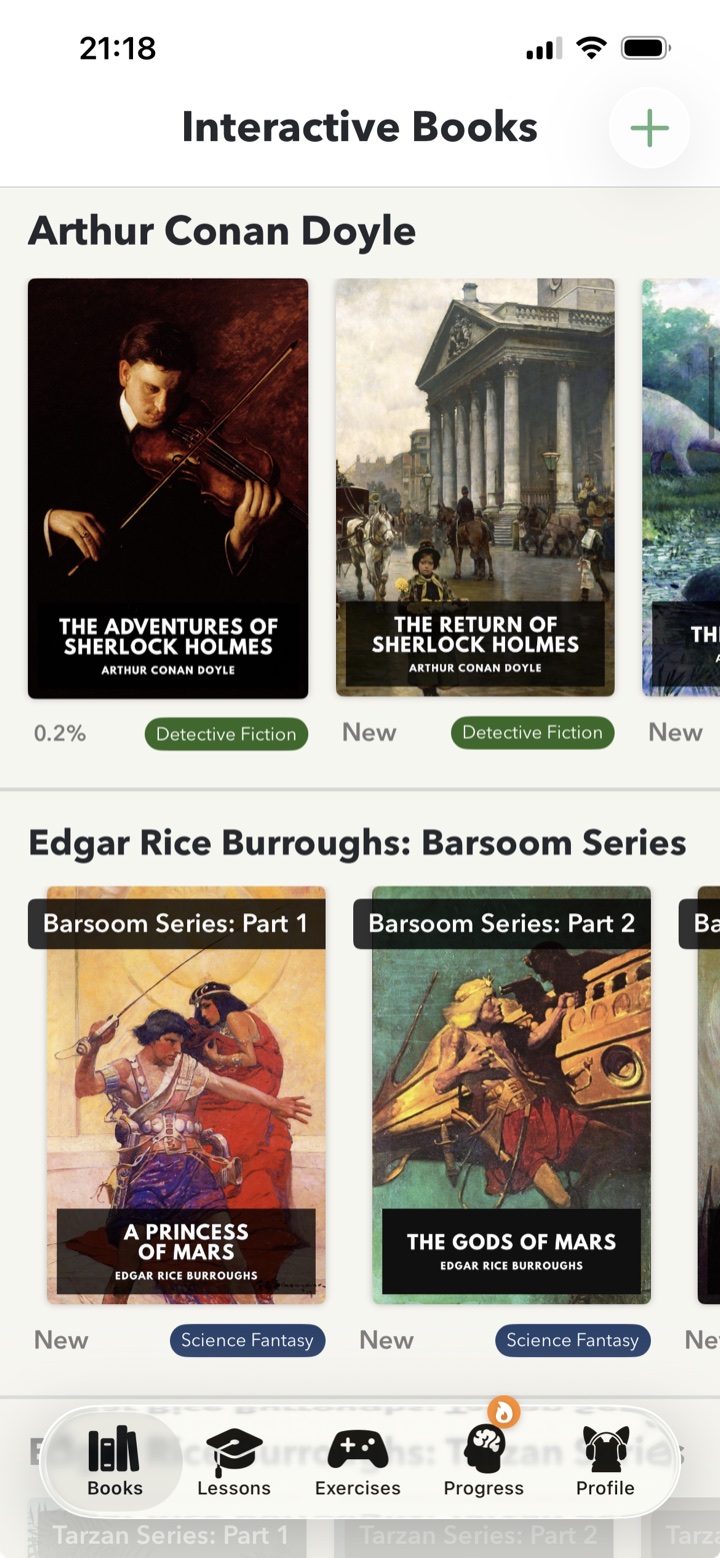
Word lists run out. 61 books, each sentence printed with English directly beneath it and every book graded by reading difficulty, so you can start one before you feel ready. The device above is Ein Skandal in Böhmen — Conan Doyle’s first Sherlock Holmes story, in German.
- The Adventures of Tom SawyerMark TwainEasy
- The Adventures of Sherlock HolmesArthur Conan DoyleEasy
- The Wonderful Wizard of OzL. Frank BaumEasy
- A Christmas CarolCharles DickensEasy
- Peter PanJ. M. BarrieEasy
- The Adventures of PinocchioCarlo CollodiEasy
Read your first German book
Free on the App Store

Scan to install on your iPhone